
The missing middle in Hong Kong's maritime workforce
The city wants to expand its role in global shipping, but its maritime ambitions face a stubborn recruitment problem. Finding graduates is one thing; attracting and retaining the experienced professionals needed to run an international maritime centre is quite another.
Hong Kong has no shortage of ambitions for its maritime industry. It wants to become a centre for green fuel trading, ship finance, digital technology and sophisticated fleet management. But there is one asset that cannot be imported overnight: an experienced marine superintendent who has spent years at sea and knows how to keep an increasingly complex fleet operating safely.
The city’s problem is not simply persuading school-leavers to consider a career in shipping. It is attracting and retaining the people 10 or 15 years further along, when hard-won technical knowledge meets commercial judgment and when employers in Singapore, mainland China and industries far beyond shipping are competing for the same individuals.
The Vocational Training Council’s latest maritime manpower survey counts 25,993 employees in 2024, including non-Hong Kong seafarers, with 13,746 in shore-based jobs. It records just 384 vacancies, including 192 ashore, but a 9.1% turnover rate among shore-based staff. A low snapshot vacancy rate does not mean companies can easily find a chief engineer turned superintendent, an experienced claims handler or a specialist surveyor.
Richard Hext, chairman of the Hong Kong Shipowners Association, says “talent is one of the sector’s most urgent execution challenges”. Hong Kong needs not just new graduates, he argues, but professionals who can move from seagoing and technical roles into commercial and leadership positions.
Earlier VTC research identified a hollowed-out middle in high-value maritime services, with senior staff nearing retirement and junior employees still acquiring experience. It also identified a shortage of people with seagoing qualifications for jobs such as port captain, technical superintendent and ship surveyor. Even the Marine Department has struggled to fill its specialist positions.
At classification society RINA, the shortage is practical rather than theoretical. Brian Yam, its commercial director for Hong Kong and Taiwan, says one particular difficulty is hiring experienced ship surveyors locally. Local pathways into naval architecture and marine engineering are limited, and relatively few Hong Kong youngsters spend the years at sea needed to acquire the qualifications and experience employers want.
There is a fundamental timing problem. A short course can teach a new regulation; it cannot produce the judgment gained from an engine-room failure, a drydocking or years of managing crews and contractors.
Shipmanagers are responding by building their own career ladders. Anglo-Eastern chief executive Bjorn Hojgaard says five members of the company’s executive management team started their careers at sea and approximately 75% of its shore managers have been promoted from its seagoing workforce.
“Mid-career is the point where many professionals weigh a move into adjacent sectors,” he says. Employers must offer progression, mentoring and competitive rewards before valuable experience walks out of the maritime sector altogether.
Hong Kong is also competing on quality of life. Housing costs, education, family considerations and alternative careers in finance, technology and family offices affect whether a specialist accepts a posting or stays for the long term. Tax concessions for maritime businesses are of limited use if they create additional corporate structures without bringing experienced decision-makers and their families to the city.
Vikrant Gusain, chief executive of Dockendale Group, makes a revealing point about the labour market. At mid-career, people make decisions based on “career optionality — having 10 potential employers rather than two”. An attractive maritime centre therefore needs competing companies, not merely a few very large ones. Recruitment becomes easier when changing jobs does not also mean changing countries.
Insurance faces much the same challenge. Deborah Yu, regional director for Asia at London P&I, says: “Mid-career professionals are mobile and have attractive opportunities in many other regional hubs.” Underwriters, claims handlers and specialist surveyors need both competitive remuneration and credible prospects of advancement.
The technical requirements are changing, too. Methanol and ammonia, cyber security, emissions verification, remote monitoring and AI are creating new jobs while changing established ones. Ioannis Stefanou, managing director of shipmanagement at Wallem Group, says the competition for skilled professionals extends far beyond shipping. The industry needs to show younger recruits that maritime careers are global, technologically advanced and connected to decarbonisation rather than simply selling a lifetime of paperwork and port calls.
There are signs of action. The Hong Kong Shipowners Association launched its academy earlier this month, building on a 16-organisation Maritime Talent Cultivation Alliance established last year. The academy is intended to upgrade members’ knowledge and skills, not simply introduce schoolchildren to the industry. The government’s September policy address also proposed a maritime academy and an institution-enterprise training model with clearer cross-disciplinary career pathways.
Training already has tangible public backing. Hong Kong pays eligible deck and engineer cadets HK$10,000 a month during qualifying sea service, and its maritime training fund supports further professional courses and examinations. In April, the government and industry partners organised a train-the-trainer programme on green marine fuels, recognising that new bunkering infrastructure is of little value without people who know how to use it safely.
Hext says maritime careers must become “more visible, portable and future-facing”. Structured internships, recognised sea-to-shore qualifications and mid-career transfers could help turn isolated training programmes into genuine progression routes.
The next test is not how many academies open or how many students attend a career fair. It is how many surveyors, fleet managers, brokers, claims specialists and marine engineers actually take posts in Hong Kong, and how many remain five years later.
The city can fund a ship, register it and insure it. Keeping the know-how needed to operate all three businesses may be the more demanding investment.
This is an extract from our brand new magazine being distributed across Hong Kong Maritime Week. You can access the full magazine for free by clicking here .
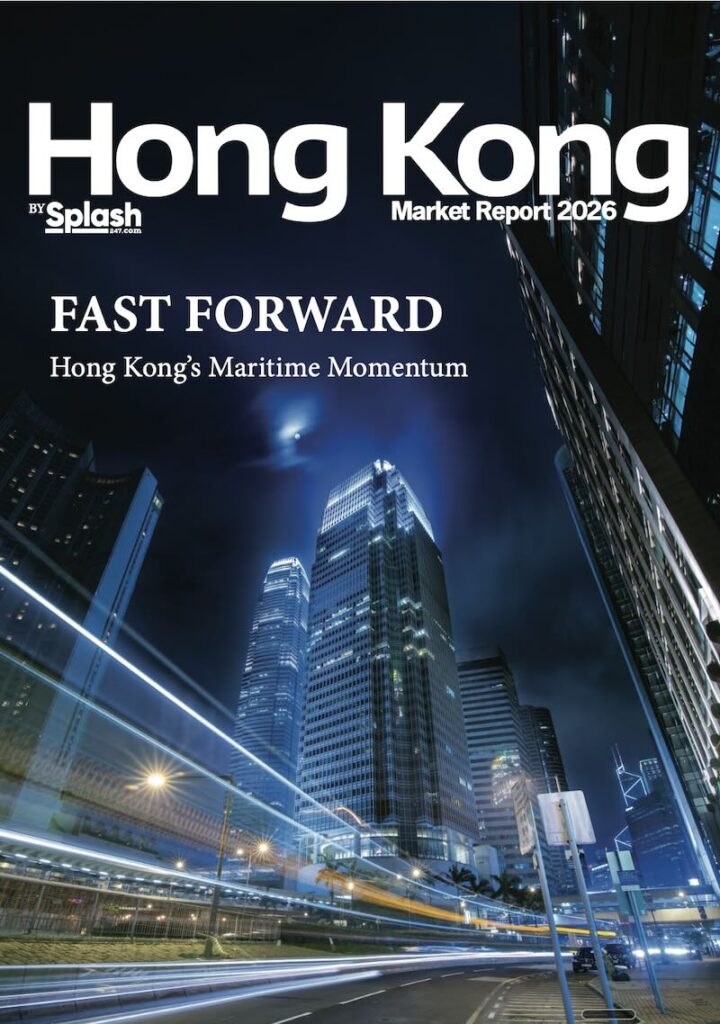
Image source: Splash247
source:Splash247
- Evergreen's 24,000 TEU Ever Acme delivered 4 months ahead of schedule
- Major Chinese ports container volume up 2% in late November
- Japanese insurers to halt ship insurance for all of Russia
- Xeneta container rates alert: calm before storm, as long-term ocean freight rates hold steady ahead of expected new year pain
- APL England's box loss report finds ship's lashings in poor shape
